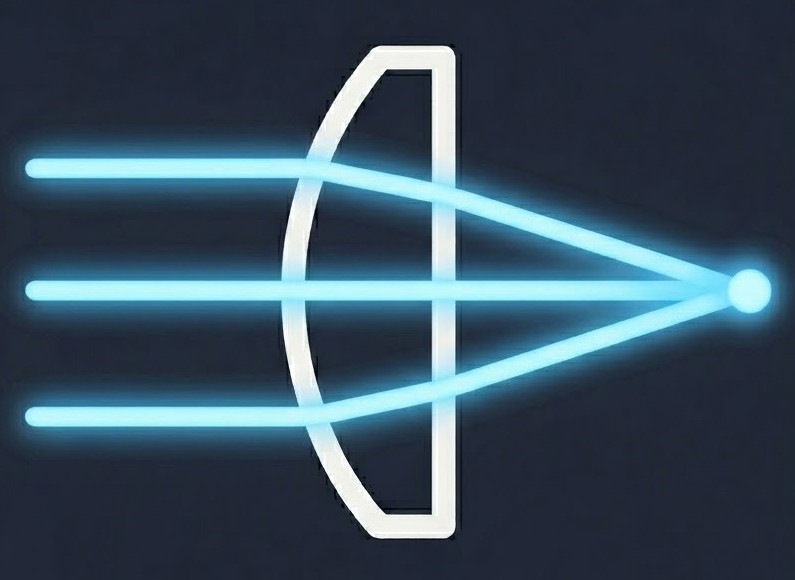
Classic optical systems, fully ray-traced.
Each schematic is produced by the real ray tracer - accurate ray paths, correct colors, real element dimensions. Open any system in the workspace and edit every element.
Keplerian Telescope
Two positive lenses separated by f1 + f2. A collimated input exits collimated and expanded by f2/f1 (here ×3), with an internal focus between the lenses.
Galilean Telescope
A positive objective and a negative eyepiece separated by f1 − |f2|. The beam is compressed without ever coming to a focus.
Newtonian Telescope
Starlight fills the aperture around a central obstruction (blocker + thin diagonal, as in a real reflector). The parabolic primary focuses the annular beam back onto the 45° diagonal, which folds it sideways through the focus to an on-axis eyepiece.
4f Imaging Relay
Two f=100 lenses spaced 2f apart. The object sits at the front focal plane of L1 and is re-imaged 1:1 (inverted) at the back focal plane of L2.
Single-Lens Imaging
An off-axis point object 150 mm in front of an f=100 lens is imaged 300 mm behind it (1/150 + 1/300 = 1/100), inverted and magnified ×2 - the chief ray passes the lens center undeviated.
Chromatic Aberration
White light through a single dispersive glass lens (n decreases with increasing wavelength): blue rays bend more and focus closer than red, smearing the focus along the axis - the defect achromats are designed to cancel.
Achromatic Doublet
A positive crown lens (weak dispersion) paired with a negative flint lens (strong dispersion) whose powers satisfy the achromat condition - red and blue come to nearly the same focus, unlike the single lens.
Prism Spectrometer
A narrow white beam refracts through an equilateral prism near minimum deviation; strong chromatic dispersion (dn/dλ < 0) fans the colors across a wide detector centered on the deviated beam.
Grating Spectrometer
A transmissive 600 lines/mm grating diffracts a single narrow white beam; the first-order fan spreads the spectrum across a wide detector.
Periscope
Two flat mirrors at 45° translate the beam sideways while preserving its direction - the basic building block of beam steering and periscopes.
Gaussian Focus (Fields Beta)
Collimated Gaussian beam focused by a thin lens. Use Beta → Fields → Compute to see the continuous intensity on the sensor and incoherent volume slices along the path.
Beamsplitter Split (Fields Beta)
Transmitted and reflected arms each end on a sensor. Fields Compute builds coherent maps per terminal; compare power and polarization between arms.
Crossed Polarizers (Fields Beta)
Unpolarized Gaussian through a polarizer, waveplate (optional identity), and crossed analyzer. Fields Compute shows residual intensity from Jones modes.