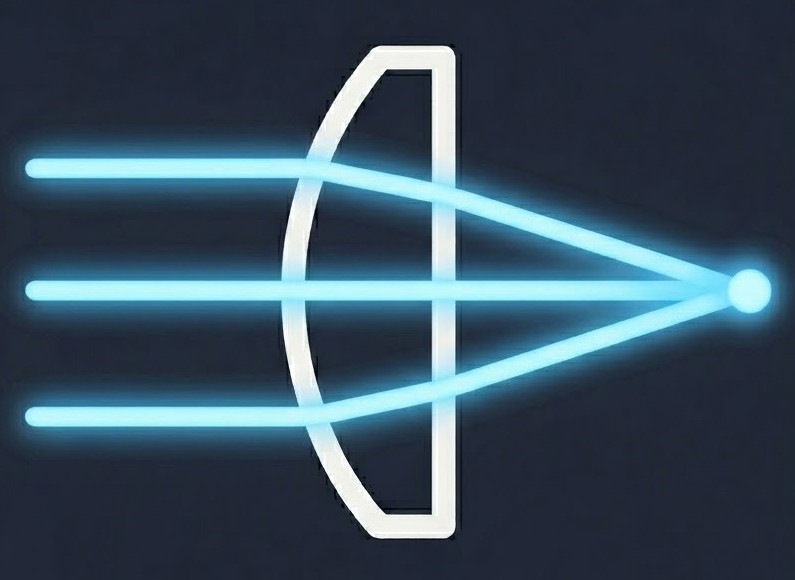
Communicate optical concepts as fast as you think them.
OpticSketcher is a browser-based optical diagram tool for engineers who need to sketch, discuss, and present optical setups - without opening full optical design software.
The gap between slides and simulation software
Most optical layouts are communicated one of two ways: drawn by hand in PowerPoint or a generic diagram tool, or built in full optical engineering software. The first is fast but physically meaningless - rays go where you draw them, not where light would actually go. The second is rigorous but heavy: licenses, setup files, and far more precision than an early concept needs.
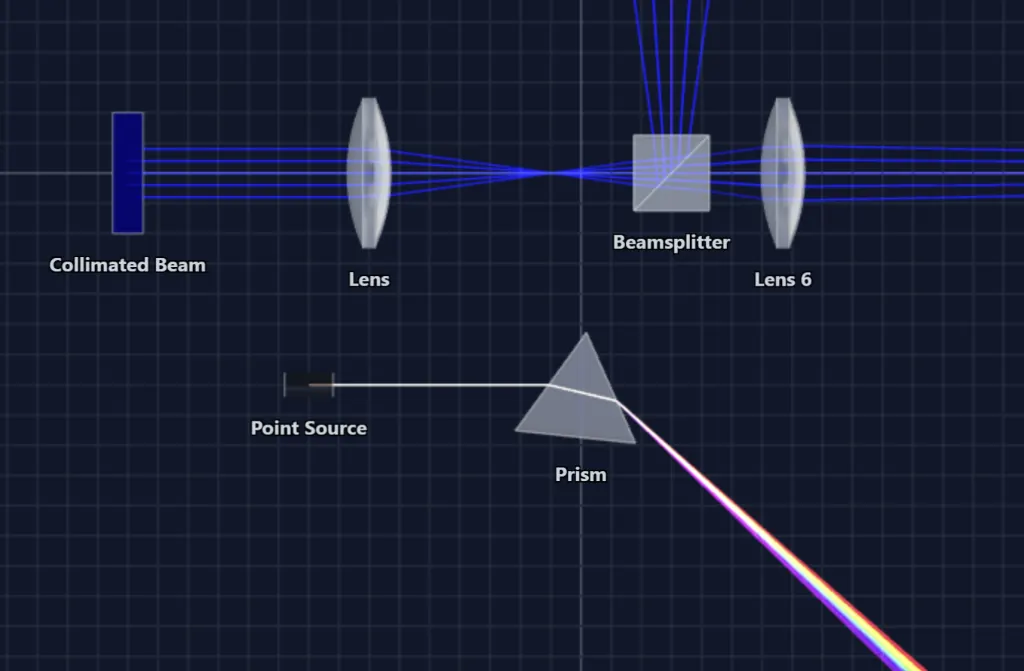
OpticSketcher sits in the practical gap between the two. It is an optical system sketch tool where every diagram is backed by real ray tracing - reflection, refraction, dispersion, and polarization computed live as you drag components. Your sketch is quick like a slide, but it behaves like the physics.
Where engineers use it
Experimental layouts
Early concepts
Design discussions
Proposals & documents
Presentations
Accurate enough to trust, fast enough to use daily
Because the optical behavior is calculated - vector Snell refraction, Sellmeier material dispersion, a full Stokes/Mueller polarization pipeline, waveplates, Faraday rotators, and diffraction gratings - the diagram you present is also a sanity check on the concept behind it. If a folded beam path or polarization-based isolation scheme works in the sketch, you have a meaningful first confirmation before committing to detailed design.
Read more about the models on the Optical Physics & Simulation page , or explore ready-made setups in the Example Gallery .